REVIEW · REYKJAVIK
Snaefellsnes Peninsula Self-Guided Driving Audio Tour
Book on Viator →Operated by Guide With Action · Bookable on Viator
A trip to Snæfellsnes feels like one long postcard. This self-guided driving audio tour turns that drive into a story loop, with offline maps and GPS-triggered commentary that you can pause and restart whenever you want. I especially like the freedom to explore at your own speed and the way the narration makes each stop feel connected. One thing to keep in mind: you are managing your own timing and phone setup, since there’s no live guide in the car.
You’ll cover about 89 miles of western Iceland, with more than 83 audio stories over roughly 3 to 4 hours. It’s priced per group (up to 4), which makes it a budget-friendly alternative to bus tours when you’ve got a car and a little curiosity. The biggest value for me is that you can download once, then keep going without worrying about signal.
In This Review
- Why the GPS audio format makes Snæfellsnes easier
- Quick takeaways before you drive
- Getting the app right (so the tour feels smooth)
- Route basics: timing, distance, and what that means
- From the visitor center to the first big stories: Djúpalónssandur, bulls, and black-roof church energy
- Beaches and folklore: seals, Lady of the Mountain, and huldufólk wedding jokes
- Snæfellsjökull and the crater-and-cave sequence you’ll actually want
- Arnarstapi, Gatklettur, and the basalt coastline “diagram” effect
- Lighthouses near Malarrif and the western tip: when color helps in fog
- Hellissandur, Street Art, and small-town museum time
- Waterfalls with real context: Svodufoss, Bæjarfoss, and Kirkjufell
- Grundarfjörður to your final panorama: Berserkjahraun and Kolgrafarfjördur
- Price and value: why splitting a $49.99 car tour can win
- Who this tour suits best
- Should you book this Snæfellsnes audio drive?
- FAQ
- How long is the Snæfellsnes Peninsula self-guided driving audio tour?
- About how much driving is included?
- Does the tour work offline without cell service?
- Do I need strong Wi‑Fi or cellular to start?
- Can I pause and restart the audio whenever I want?
- How much does it cost, and is it per person?
- Are attraction tickets and cave entry included?
Why the GPS audio format makes Snæfellsnes easier

This tour is built for drivers who want the highlights without the stress of route planning. You start at the Snæfellsnes Visitor Center, and the audio begins automatically when you reach the first story point. From there, the stories play based on your location, so you’re not constantly checking your phone or guessing where you are in the sequence.
The other big win is offline mode. You won’t need cellular or Wi‑Fi while you’re driving. For a peninsula where signal can be spotty, that matters more than people think. Download the tour while you’re on strong Wi‑Fi or cellular, then treat your phone like a guidebook with a map that doesn’t quit.
One more practical benefit: lifetime access. There’s no expiry date, so you can reuse it on another Iceland trip or even come back later and replay the stories you skipped the first time.
Quick takeaways before you drive
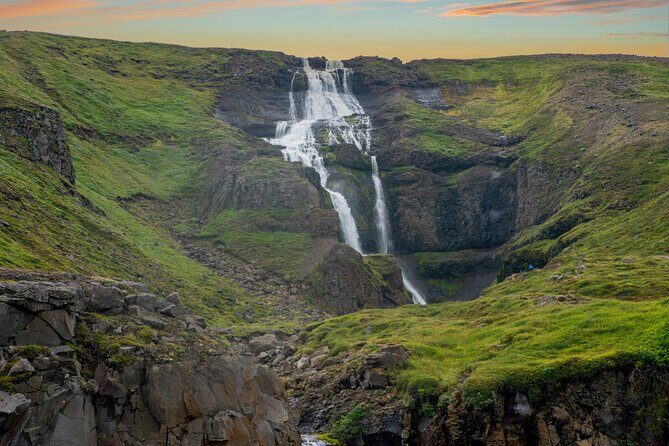
- Offline from the start: all maps and commentary are available without signal after download.
- Pause, restart, repeat: you control the playback during photo breaks or repeat visits.
- Built for one car, not one person: the price is per group up to 4, so it’s easy to split.
- Hands-free storytelling: audio plays on its own when you’re at the right spots.
- Expect lots of stops: you’ll see churches, beaches, craters, waterfalls, and lighthouses without changing apps constantly.
You can also read our reviews of more guided tours in Reykjavik
Getting the app right (so the tour feels smooth)
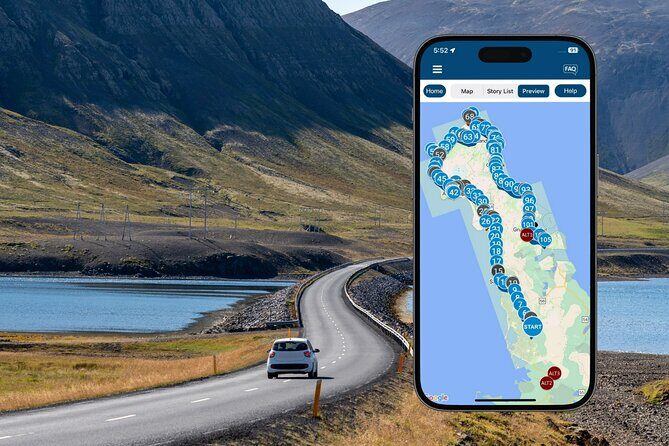
Plan for setup before you roll. After booking, you’ll get an email and text with setup instructions and a password. You also need to download the separate tour app from Action while you have strong Wi‑Fi or cellular. Once downloaded, the tour works offline.
When you’re ready on-site:
- Open the Action tour app at the start point.
- If there’s more than one tour option, pick the one matching your planned starting direction.
- Audio will begin automatically at the first story point.
For audio in your car, you’ve got options: Bluetooth, USB, or AUX. If you want a louder, clearer experience while driving, connecting through the car stereo usually wins. If you’re walking short segments at stops, you might prefer headphones so you don’t miss any details while standing in wind and drizzle.
Compatibility note: audio playback works with Apple CarPlay, and Android Auto support is on the way. If you’re bringing your phone anyway, make sure it’s charged. The tour lives on GPS and audio playback, so battery is your one real dependency.
Route basics: timing, distance, and what that means
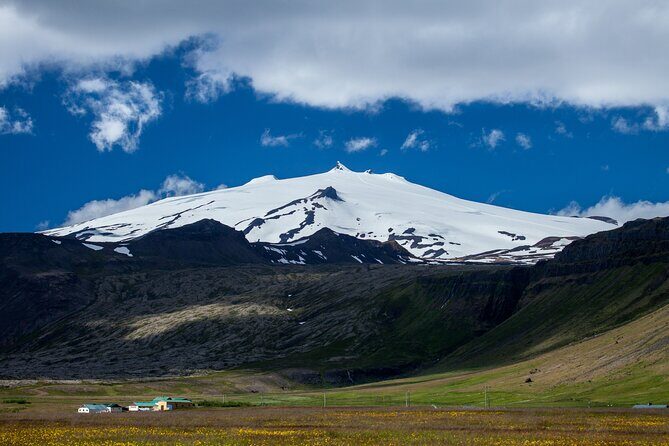
The driving loop is about 89 miles long, and you’ll spend roughly 3 to 4 hours completing it, depending on how long you linger at each stop. The tour is designed around short visits—many stops are around 5 minutes—so it works best when you treat it like a curated drive, not an all-day road trip with long hiking.
You can still slow down. Just remember: the audio guide is location-based, so keep moving along the route at a reasonable pace. If you stop for a long time, the narration may pause naturally until you’re back near the next trigger point.
Also, this route isn’t about a single big “wow” moment. It’s about stacking many good moments: churches with long histories, mineral springs, dramatic coasts, basalt geometry, caves, and the peninsula’s repeating cast of lighthouses and waterfall viewpoints.
From the visitor center to the first big stories: Djúpalónssandur, bulls, and black-roof church energy
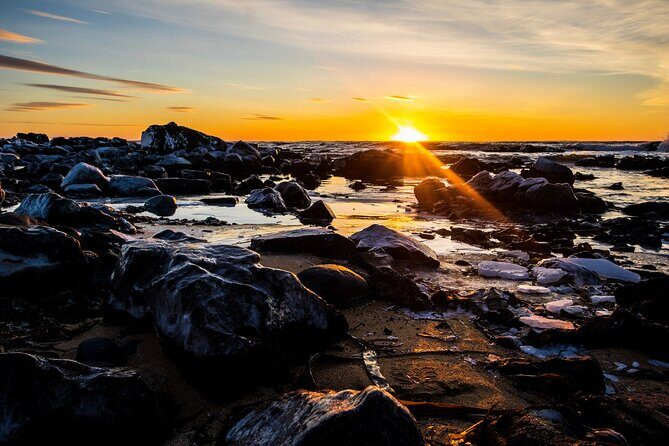
You begin at the Snæfellsnes Visitor Center, then roll into the peninsula’s myth-and-geology mix right away.
One of the tour’s early emotional tones comes from the Djúpalónssandur area. Just below the parking lot, two lagoons sit near the beach. The audio describes how, in the 1100s, a Catholic bishop blessed the pools and people believed in healing powers. If you follow the trail known as Nautastígur—The Path of the Bulls—you connect a place to working-farm history, since farmers once brought bulls to drink from the lagoons. This is the kind of stop that helps you “read” the coast beyond the photos.
Then you move toward Ingjaldshólskirkja, a famed church site with an old presence since the early 1300s—even though the current structure dates to 1903. This is a good moment to appreciate how Snæfellsnes holds layers. Iceland’s religious story often isn’t a single building; it’s continuity in a location.
Next comes Ölkelduvatn mineral spring at Ölkelda farm. The tour explains what’s happening chemically—minerals and the rusting process—so you’re not just looking at water, you’re understanding why it can leave a reddish effect. This is a rare case where a quick stop feels like it teaches you something you can use later.
Beaches and folklore: seals, Lady of the Mountain, and huldufólk wedding jokes
Ytri Tunga Beach is a short stop with a long-feeling story. The audio recounts how a young farmer found a seal skin at night and later discovered a crying young woman who seemed connected to the seal skin in a folktale twist. You’ll see why coastal places in Iceland inspire stories: the sea is both food and mystery.
After that, Bjarnarfoss brings the peninsula’s folklore into a waterfall stop. The audio references the Lady of the Mountain, a legendary matriarch locals consider the embodiment of Iceland itself. Even if you’re not a myth person, that kind of story choice nudges you to look longer at the waterfall’s flow and the rock wall it feeds.
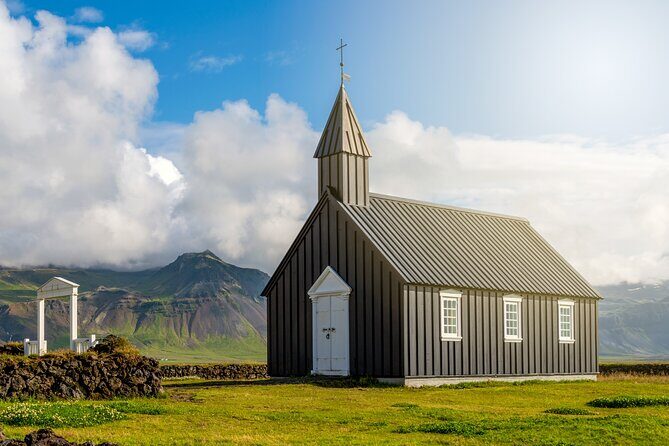
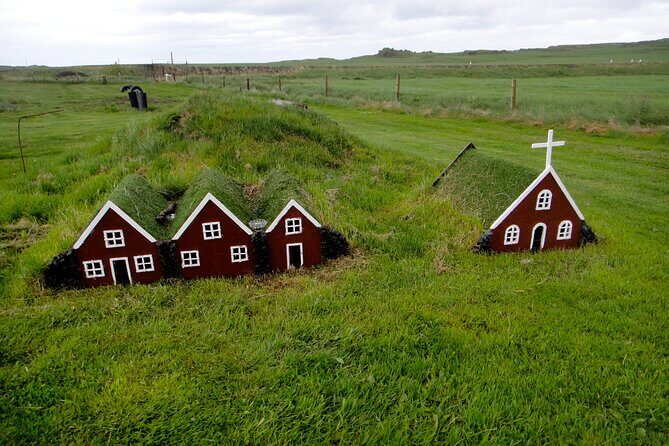
Then you reach Búðakirkja, another church stop framed with huldufólk folklore. The narration points out the small size and leans into the idea of a possible huldufólk wedding. It’s playful, and it’s timed well: it breaks the geology rhythm without turning the whole tour into pure legend.
A few more Reykjavik tours and experiences worth a look
Snæfellsjökull and the crater-and-cave sequence you’ll actually want
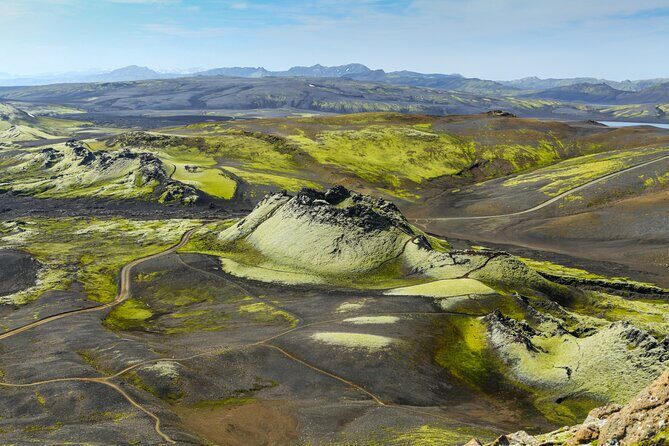
Snæfellsjökull View Point is one of the tour’s science-plus-awe stops. You’ll hear how Snæfellsjökull combines a glacier and a volcano, and you’ll also learn that the ice has shrunk over decades. The tour even points out an eye-opening change: in 2012, for the first time in human history, you could stand there and see no ice on the top of the volcano. That’s a powerful way to turn a viewpoint into something current.
From there, Rauðfeldsgjá Gorge adds a short, more physical option. The audio describes a deep rocky ravine with a small waterfall, and it notes a half-mile trail that can take about 20 minutes in summer. This is the main stop where you might stretch beyond a quick photo and actually do a small walk. If it’s windy or muddy, slow down—this is Iceland, and grip matters.
Sönghellir Cave, or Cave of Songs, is the next creativity hit. The audio calls out the twisting rocky walls and the echo effect, with some saying the echoes are the songs of the huldufólk. It’s a nice way to set expectations: you’re going in to experience sound, not just rocks.
Arnarstapi, Gatklettur, and the basalt coastline “diagram” effect
The tour includes an optional detour to Arnarstapi, the tiny fishing village where cliffs get dramatic fast. The audio highlights craggy overlooks, a stone arch, and even a natural bridge. This is also where the troll connection comes in, with Bárðar Snæfellsás, which gives Arnarstapi a cultural anchor beyond the scenery.
Afterward, you’ll hear about Gatklettur and the natural harbors that once brought fishermen and helped the village become a bustling port. Even if you can’t imagine herring coming in at night, you’ll start noticing the coastal shapes that would make it possible.
Then the route sets you up with Lóndrangar View Point: two basalt columns rising above the cliffs. The audio even ties the view to the area’s nickname, the rocky castle. Basalt columns are one of those Iceland visuals that feel almost engineered. The more the story connects shape to place, the easier it is to remember later.
Lighthouses near Malarrif and the western tip: when color helps in fog
Malarrif Lighthouse is built for sailors in tricky basalt cliff terrain, and the tour describes its distinctive rocket-like shape. It’s a quick stop that still feels meaningful, because lighthouses on Snæfellsnes aren’t just decoration—they’re survival tech.
After that, Svörtuloft Lighthouse and Öndverðarnesviti keep the tone. Svörtuloft is bright orange against darker lava cliffs, built in 1931. Öndverðarnesviti was built in 1973 to help navigate the peninsula’s rocky tip. If you’re driving in poor weather, those colors can act like mental landmarks, even when visibility is low.
Hellissandur, Street Art, and small-town museum time
Hellissandur is a shift from pure nature to a town with personality. The audio notes it was once a thriving fishing village and is now known as the Street Art Capital of Iceland. You’ll see big murals and galleries along the main road, plus a draw called the Maritime Museum.
Even though this is a driving audio tour, I like that it doesn’t treat towns as just fuel stops. It gives you a reason to get out and look at walls, not only horizons.
Waterfalls with real context: Svodufoss, Bæjarfoss, and Kirkjufell
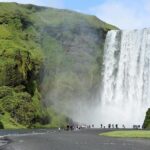
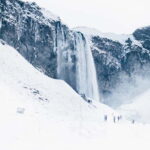
The tour then turns to waterfalls, and it gives you a big-picture explanation: glacier melt helps sustain nearly all the waterfalls on Snæfellsnes. That makes Svöðufoss easier to understand on the spot. You’re not just seeing water falling; you’re seeing the glacier feeding the system.
Bæjarfoss gives you an easier walk viewpoint that overlooks Ólafsvík. The audio says it translates to Town Falls and is an easy walk from town. If you want a break from driving without committing to a hike, this is a good candidate.
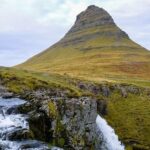
Then you get the iconic Kirkjufell Mountain behind Kirkjufellsfossar. The audio doesn’t just name the spot; it mentions how it’s familiar if you’ve seen Game of Thrones. Even if you’re not, the silhouette is instantly recognizable when you’re there.
The tour also adds a small geography lesson with Kirkjufell Viewpoint. It explains that Kirkjufell is a nunatak—mountain peaks rising above surrounding glaciers—and that erosion shaped its sheer sides and cylindrical form. That kind of explanation changes how you look at the mountain. You stop seeing it as a random shape and start seeing it as a leftover from glacial work.
Grundarfjörður to your final panorama: Berserkjahraun and Kolgrafarfjördur
Near the end, you reach Grundarfjörður, positioned at the edge of Berserkjahraun, a wide lava field. The audio ties the location to the Eyrbyggja saga, mentioning a 10th-century farmer named Viga-Styrr who used two muscular berserkers to work fields. It’s another reminder that Iceland’s place names and legends often grow from the same physical terrain you’re watching now.
Finally, the tour wraps up at Kolgrafarfjördur Viewpoint with a grand panorama. This is your chance to look back across basalt cliffs, ancient volcanic features, and dark lava fields, all the pieces you’ve been collecting since the visitor center.
Price and value: why splitting a $49.99 car tour can win
At $49.99 per group (up to 4), this isn’t priced like a per-person bus trip. It’s closer to paying for a self-guided guide you can share. If you’ve got two people in your car, it can be cheaper than paying for guided transport and you avoid schedule pressure.
You’re also getting a lot for the time. The tour includes 3 to 4 hours of content, 83+ audio stories, and offline support, which is not just a convenience—it’s part of what makes the driving doable without constant map stress. Add lifetime access, and the value climbs if you plan to return to Iceland or just like re-listening while you compare memories.
Also, many stops are marked as free admissions on the route. That matters, because you’re not forced into paid attractions to make the tour worth it. One caution: the tour specifically says attraction passes, entry tickets, or reservations aren’t included. If you want to go inside specific caves or ticketed sites, you may need to handle that separately.
Who this tour suits best
This works especially well if:
- You like driving and hate route-planning chores.
- You want narrative context, not just signposts.
- You’re traveling with up to 3 people and can split the price.
- You enjoy short walks and quick photo stops, not long hikes.
It’s also a good match for repeat visitors. Since the app is GPS-triggered and you can pause and restart anytime, you can come back later and focus only on your favorite stops.
If you need a hands-on guide to manage timing, crowds, or complex stops, this may feel a bit too independent. But if you’re the type who likes to set your own pace, the audio format is made for that.
Should you book this Snæfellsnes audio drive?
If you’re doing Snæfellsnes and you want the highlights without overplanning, I’d book it. Offline maps alone make it feel safer in real driving conditions. The story approach also helps you move through the peninsula with purpose, not just windshield time.
Skip it only if you strongly prefer a live guide, or if you’re not comfortable downloading an app in advance and managing audio while driving. In a place where weather can change quickly, having a phone ready with battery and downloaded content is the one practical requirement you can’t ignore.
FAQ
How long is the Snæfellsnes Peninsula self-guided driving audio tour?
It takes about 3 to 4 hours to complete.
About how much driving is included?
The tour covers more than 89 miles.
Does the tour work offline without cell service?
Yes. The tour includes offline maps and offline audio commentary after you download the tour app.
Do I need strong Wi‑Fi or cellular to start?
You must download the tour while you are on strong Wi‑Fi or cellular. After that, it works offline.
Can I pause and restart the audio whenever I want?
Yes. You can pause or restart the app during the tour, including on repeat visits.
How much does it cost, and is it per person?
It costs $49.99 per group, up to 4 people.
Are attraction tickets and cave entry included?
No. Attraction passes, entry tickets, or reservations are not included.